
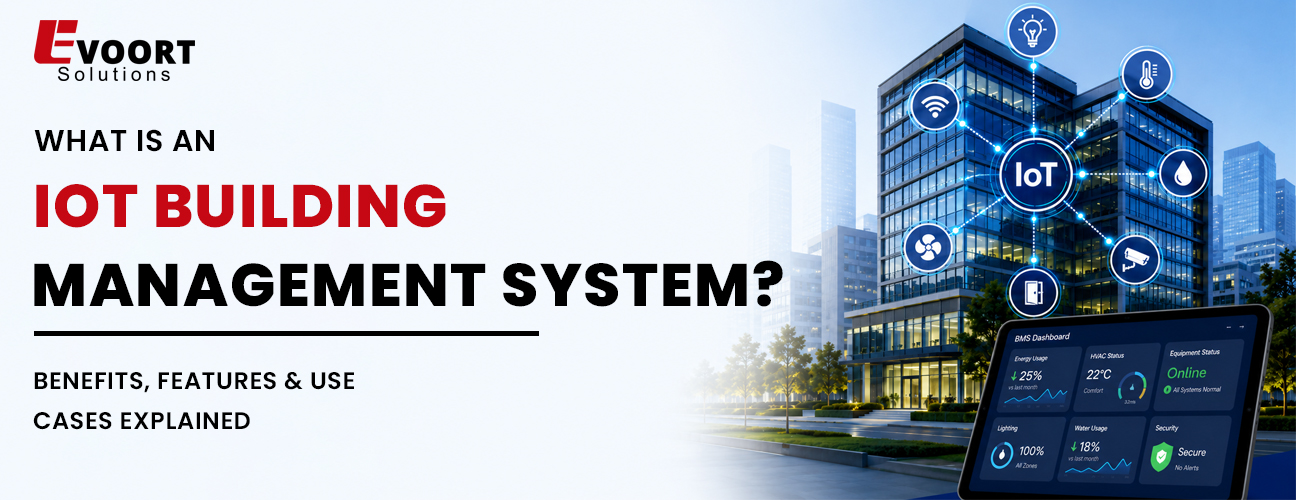
What Is an IoT Building Management System? Benefits, Features & Use Cases Explained
Table of Contents
Today’s buildings have become smarter, more connected and energy efficient. Whether these are commercial office spaces, hospitals, manufacturing units or residential buildings, organizations today are using IoT technology to increase efficiency in their work and decrease wastage of energy.
This uses different sensors, automation, connectivity in the cloud, and real-time analytics to make it easier for businesses to monitor and control the processes in their buildings. In this blog, we are going to discuss the IoT Building Management System, its working, features, benefits, applications in different industries, and upcoming trends in this area for 2026.
What Is an IoT Building Management System?
An IoT Building Management System is an advanced platform that integrates building infrastructure like heating, ventilation and air conditioning, lighting systems, security systems and energy and equipment infrastructure through IoT. Data is collected in real-time from devices and automation is used to increase the efficiency of buildings.
Different from conventional building management systems, the IoT BMS platforms have cloud connectivity, remote monitoring, predictive analysis and automated actions.
How It Works
The sensors that are placed around the building provide inputs such as temperature, humidity, occupancy, energy consumption and machine status. This data is sent to cloud platforms where it is analyzed and displayed through centralized dashboards. Depending on certain rules or even artificial intelligence-based insights, automation of certain tasks can be triggered by the system.
Key Components
1. Sensors
These devices detect the surrounding environment, occupancy, air quality, movement, temperature and equipment status.
2. IoT Devices
Internet-of-things devices collect and communicate the operating data within the buildings.
3. Cloud Platform
The cloud technology platform facilitates the storage of massive volumes of building data securely.
4. Analytics Dashboard
The dashboard software provides visualization of the building performance and energy use data.
Key Features of an IoT Building Management System
1. Real-Time Monitoring
IoT-based BMS systems ensure continuous monitoring of operations in the facility through real-time monitoring. Facility managers will be able to monitor energy consumption, equipment performance and other environmental factors through one dashboard.
2. Energy Management & Optimization
Among the best things about an IoT-based BMS is energy optimization. This means that the smart system is able to monitor energy consumption, adjusting when necessary to prevent wastage.
3. Predictive Maintenance
IoT sensors can detect performance issues before equipment fails. Predictive maintenance helps organizations reduce downtime, extend equipment lifespan and avoid expensive emergency repairs.
4. Remote Access & Control
An IoT-enabled building management system uses sensors to determine problems in advance before equipment breaks down. This improves flexibility and operational efficiency.
5. Smart Alerts & Automation
The system can instantly generate alerts for equipment failures or unusual energy consumption. Automations within such building management systems help reduce human intervention.
Top Benefits of IoT Building Management Systems
1. Reduce Energy Costs
Energy expenditure is one of the biggest operational costs associated with modern buildings. IoT building management systems allow for minimizing unnecessary energy consumption through automation and efficient control.
Smart energy optimization can significantly lower electricity and utility bills over time.
2. Improve Operational Efficiency
Centralized access to information from all systems allows building managers to avoid having to monitor everything manually, while automation also cuts down on repetitive tasks.
3. Enhance Occupant Comfort
A smart climate management system, automatic lighting control and air quality monitoring provide healthy and comfortable interior living conditions for occupants.
4. Increase Security & Safety
IoT-enabled security systems allow for combining all building surveillance cameras, access control systems and alarms under one roof.
5. Data-Driven Decision Making
Real-time analysis allows organizations to make decisions based on real facts, instead of guesses.
Use Cases of IoT BMS Across Industries
1. Commercial Buildings
Office buildings make use of IoT BMS solutions for smart lighting, heating and cooling, occupancy and energy management.
2. Hospitals & Healthcare
Healthcare and hospital systems depend upon IoT solutions for environmental management, critical infrastructure and patient safety.
3. Smart Homes & Residential
Residential buildings make use of IoT-based building solutions for energy efficiency, smart appliances and remote management.
4. Industrial Facilities
Factories and manufacturing facilities utilize IoT-based building management systems for asset monitoring, maintenance and energy management purposes.
5. Educational Institutions
Educational institutions such as schools and universities employ intelligent building systems for enhancing energy efficiency and managing classrooms.
Traditional BMS vs IoT Building Management System
Conventional building management systems work via on-premise hardware solutions with minimal connectivity and manual management options. Such systems are typically used for managing HVAC, lighting and security in the building, though the automation processes of such systems may be rather basic.
An IoT-based building management system takes advantage of sensors, the cloud and automated solutions to develop a more responsive environment. Managers can get remote access to the status and operation of the facilities and receive relevant data at any time.
Key Differences
1. Connectivity
While traditional BMS systems depend on local network infrastructures, IoT BMS systems ensure cloud connectivity.
2. Data Monitoring
The monitoring abilities offered by traditional BMS systems are quite limited. IoT systems, on the other hand, collect and analyze real-time data constantly.
3. Automation
The conventional system needs higher manual interaction for making changes and maintaining the system. The IoT-based Business Management Systems allows performing automated tasks through rules and smart analytics.
4. Scalability
It is hard to scale up the conventional BMS system. On the other hand, the IoT-enabled BMS system is highly scalable and can accommodate many more systems.
5. Maintenance Approach
The traditional BMS systems adopt the approach of reactive maintenance, which is initiated after an issue arises. The IoT BMS systems can conduct predictive maintenance by detecting problems before there is any equipment failure.
6. Energy Efficiency
While traditional systems provide limited energy controls, IoT BMS provides effective energy utilization in dynamic ways.
7. Accessibility
The accessibilities of conventional BMS systems are typically limited to the physical locations where they operate.
How to Implement an IoT Building Management System
Step 1: Assess Building Needs
Identify operational challenges, energy goals and areas requiring automation or monitoring.
Step 2: Choose the Right IoT Platform
Select a scalable IoT platform that supports integration with existing building systems and devices.
Step 3: Install Sensors & Devices
Deploy IoT sensors, smart controllers and connected devices across the building infrastructure.
Step 4: Integrate Systems
Connect HVAC, lighting, security, energy and operational systems into one centralized platform.
Step 5: Monitor & Optimize
Continuously monitor building performance and optimize operations using analytics and automation.
Future Trends in IoT Building Management
1. AI-Powered Automation
Artificial intelligence will keep on evolving in the domain of predictive maintenance, energy optimization and decision-making.
2. Digital Twins
Digital twin technology helps businesses create virtual replicas of buildings for simulation, monitoring and optimization.
3. Smart Cities Integration
IoT-based buildings will become more integrated with smart city infrastructure.
4. Sustainability & Green Buildings
The desire to achieve sustainability is creating demands for systems that minimize carbon emissions and increase energy efficiency.
Why Choose Evoort Solutions for IoT Building Management?
Evoort Solutions provides a scalable IoT building management system that aims at enhancing efficiency, optimization and real-time monitoring. It helps businesses build scalable and efficient smart building environments.
Conclusion
As buildings become more connected and energy-conscious in 2026, businesses need smarter systems that improve efficiency, sustainability and operational visibility.
Evoort Solutions helps business to implement scalable IoT building management solutions that support intelligent automation, energy optimization and real-time infrastructure monitoring for long-term business growth.
FAQs
1. What is an IoT building management system?
An IoT Building Management System refers to a connected platform that employs IoT devices, sensors and automation to control various building operations like HVAC, lighting, energy and security systems.
2. How does IoT improve building management?
IoT helps to improve building management through real-time monitoring, automation, predictive maintenance and remote control of building systems.
3. What are the benefits of IoT BMS?
The main benefits include reduced energy expenses, operational efficiency, predictive maintenance, increased occupant comfort and improved decision-making based on real-time data.
4. What is the difference between BMS and IoT BMS?
While conventional BMS solutions rely mostly on local controls with little connectivity, the IoT BMS systems utilize cloud-based solutions, real-time analysis and intelligent automation for optimized building operations.
5. How much does an IoT building management system cost?
It is dependent on the size of the building, infrastructure requirements and integration of the technology with other systems and the number of sensors needed.