
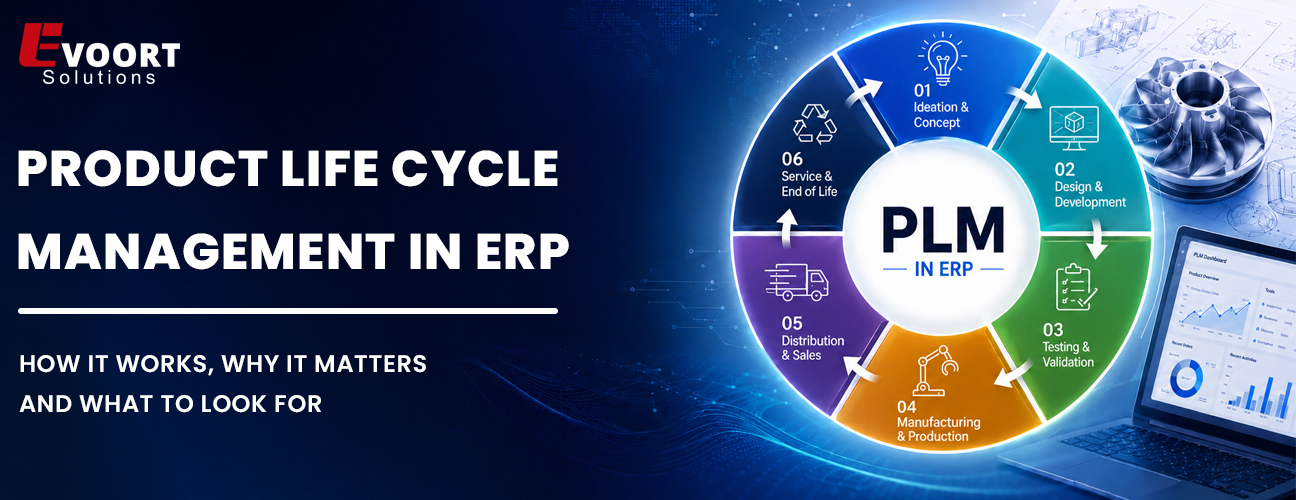
Product Life Cycle Management in ERP: How It Works, Why It Matters and What to Look For
Table of Contents
Today's companies are faced with the continuous challenge of getting their products out faster, handling changes effectively and maintaining quality through increasingly complicated processes. But despite all this, many of the organizations today rely on a disconnected and ineffective management system involving spreadsheet documents and emails to handle their product-related information.
This has led to the increasing importance of the Product Life Cycle Management in ERP system among organizations that have manufacturing-based activities. The inclusion of the product life cycle management in the ERP system means integrating the entire process related to the products into an ERP system to enhance visibility and control.
The following will explore everything you need to know about Product Life Cycle Management in ERP systems.
Why Most Businesses Manage Products Reactively
Even today, product management remains a disassociated process, where engineers work in their own systems with design management, procurement manages their procurement system and manufacturing uses its own manufacturing system.
This fragmented setup creates several operational problems:
Product data discrepancies
Design update delays
Ineffective team communication
Incorrect manufacturing due to version issues
Product launch delays
Instead of managing the product lifecycle effectively, the teams spend much time in addressing the errors. With the growing complexity of products, it is increasingly hard for product managers to address these issues.
What Is Product Life Cycle Management in ERP?
Product Life Cycle Management in ERP is defined as the management of the whole life cycle of products through the enterprise resource planning application. It involves processes such as conceptualization, design, engineering, manufacturing, maintenance and retirement of a product.
Through PLM, product information can be centralized and made available to all business units. This ensures that while in the traditional sense the process is fragmented between engineering and operations, it is integrated under ERP-based PLM.
This integration improves collaboration between:
Engineering teams
Manufacturing operations
Procurement
Supply chain management
Quality control
The result is faster decision-making and better operational alignment.
PLM Systems vs ERP-Integrated PLM
Many businesses use standalone PLM platforms, while others prefer PLM capabilities integrated directly into ERP systems.
Standalone PLM Systems
Standalone PLM solutions are usually engineer-oriented and offer extensive design management features. Still, they can have to deal with difficult integrations with ERP systems.
Challenges can include:
Duplicate data entry
Integration maintenance
Delayed synchronization between departments
PLM Inside ERP Systems
If PLM is incorporated into an ERP system, then product information is automatically sent to the stages of procurement, production and inventory control.
Benefits include:
Unified product data management
Better collaboration across departments
Reduced data duplication
Faster operational execution
For many businesses, integrated PLM provides greater efficiency and visibility across the organization.
Stages of Product Life Cycle Management in ERP
A structured PLM process supports every phase of a product’s lifecycle.
Ideation
This phase involves product concepts, requirements gathering and feasibility analysis. Teams evaluate market demand, costs and technical possibilities before development begins.
Design
The engineers design new products, prepare technical illustrations and generate bills of material. The use of ERP system integrated with PLM system helps all parties have updated information about designs.
Launch
When launching the products, planning for production, procurement and logistics become vital. ERP system integration with PLM system plays an important role in this case.
Growth
When products grow in numbers, firms need to perform product revisions and process improvement. ERP system is very useful in this stage.
Retirement
Finally, products enter their retirement stages. PLM systems assist with planning for phase-out, reducing inventories and replacements.
How Product Life Cycle Management Works in ERP
Understanding how integrated product management workflows function within ERP systems that helps businesses evaluate its operational value.
A typical workflow includes:
1. Product concepts and specifications are developed
2. Engineering builds product architecture
3. Materials bills are produced
4. Information is entered into purchasing and manufacturing
5. Production operates using approved versions
6. Changes in products are recorded
This connected workflow reduces communication gaps and ensures departments operate using accurate information.
eBOM vs mBOM: Why It Matters
One important concept in PLM is understanding the difference between engineering BOM (eBOM) and manufacturing BOM (mBOM).
Engineering BOM (eBOM)
Defines the product from an engineering and design perspective.
Manufacturing BOM (mBOM)
Represents how the product is actually built during manufacturing.
Failure to do so can create confusion and mistakes in the production process. The integration of PLM into ERP helps to ensure consistency between engineering and manufacturing.
The Real Cost of Not Having PLM in Your ERP
Many businesses underestimate the operational cost of disconnected product management systems.
Common pain points include:
Product launch delays
Expensive engineering change mistakes
Bad inventory management
More regulatory risks
Engineering rework and wastage
The implementation of two separate systems for different processes, such as engineering and ERP processes, will lead to inefficiencies and redundancy. In the long run, the cost of maintaining these two separate systems may be higher than integrating PLM systems.
7 PLM Features to Look for in an ERP
The selection of an appropriate ERP system with PLM functionality demands due diligence.
1. Centralized Product Data Management
Guarantees consistency in product information across all departments.
2. Version and Revision Control
Monitors product evolution and engineering modifications precisely.
3. BOM Management
Facilitates eBOM and mBOM management.
4. Workflow Automation
Streamlines the process of approval and change management.
5. Collaboration Tools
Enhances communication among engineering, manufacturing and purchasing departments.
6. Compliance and Documentation Tracking
Supports industry regulations and audit readiness.
7. Integration with Manufacturing Operations
Fosters synergy between design and manufacturing operations.
Industries That Need PLM in ERP the Most
Some sectors gain greatly from PLM systems that are integrated into their ERPs.
Manufacturing
Product modification, quality assurance and productivity improvement.
Electronics
Design modifications and component assembly management.
Medical devices
Assists in maintaining compliance and documentation requirements.
Automotive
Coordinating large-scale product development processes and working with suppliers.
Consumer products
Enhances time to market and lifecycle management.
5 PLM Mistakes Businesses Should Avoid
Even with the right technology, implementation mistakes can reduce effectiveness.
1. Treating PLM as Only an Engineering Tool
PLM should connect multiple departments, not operate in isolation.
2. Ignoring Change Management
Poor revision control can create manufacturing and inventory issues.
3. Using Disconnected Systems
Lack of integration creates duplicate work and inconsistent data.
4. Overcomplicating Workflows
Complex approval structures can slow down operations.
5. Failing to Plan for Scalability
Businesses need systems capable of supporting future growth and product complexity.
Conclusion
PLM in ERP is no longer merely an engineering need. Rather, it has become a core competency for companies dealing with sophisticated products, logistics and production processes.
By incorporating PLM processes into the ERP system, companies can improve collaboration, speed up product design and enhance management. With the continued trend towards connectivity and data management in different industries, PLM will prove to be essential for success in the future.
At Evoort Solutions, businesses are increasingly exploring integrated ERP and PLM strategies to improve operational visibility, product lifecycle control, and long-term scalability in competitive industries.
Discover how our PLM Solutions help enterprises streamline innovation and optimize product operations.
Frequently Asked Questions (FAQs)
1. What is Product Life Cycle Management in ERP?
Product Life Cycle Management in ERP involves the management of product development, design, production and disposition processes directly within ERP systems.
2. What is the difference between PLM and ERP?
PLM concentrates on product data and product life cycle management processes, whereas ERP is concerned with operations, finance, manufacturing and inventories.
3. Why is PLM integration important in ERP systems?
Integration improves collaboration, reduces data duplication and ensures departments work using consistent product information.
4. Which industries benefit most from PLM in ERP?
The major beneficiaries of ERP PLM include manufacturing, electronic, automobile, healthcare and consumer goods industries.
5. What are the main benefits of ERP-integrated PLM?
The major benefits include increased visibility, fast product development cycle, efficient change management, among others.