
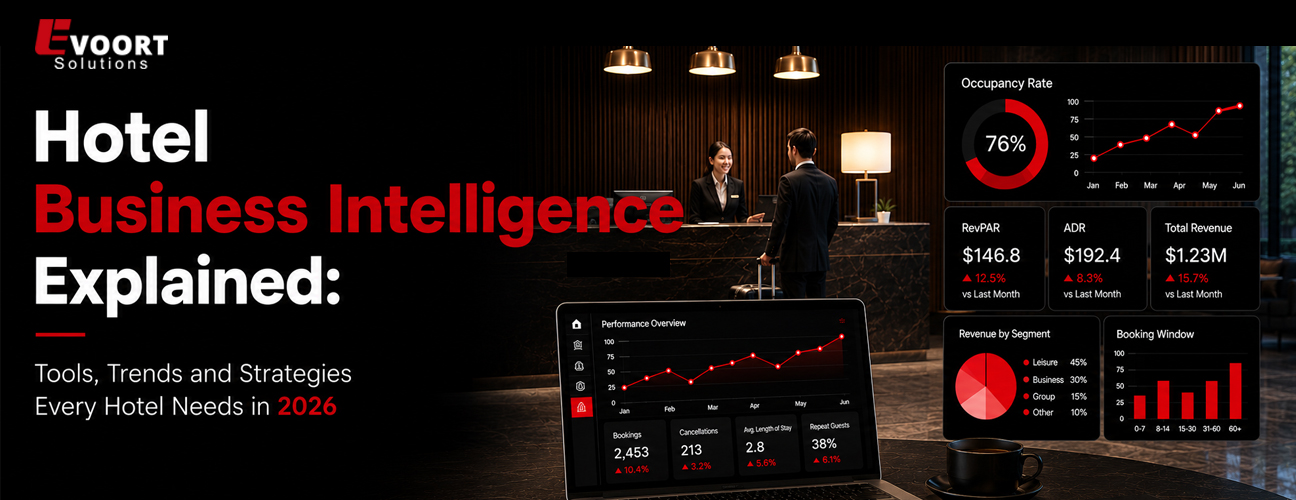
Hotel Business Intelligence Explained: Tools, Trends and Strategies Every Hotel Needs in 2026
Table of Contents
The hospitality industry is getting more competitive due to growing expectations of guests and difficulty in controlling expenses. Today hotels have huge amounts of data collected during making reservations, booking websites, guest reviews, housekeeping, restaurants and revenue management software. Nonetheless, having collected such data, hotels will not get an opportunity to use it effectively to increase their efficiency.
Here comes the importance of the business intelligence for the hotel industry. The current business intelligence solution for hotel business allows hotels to convert raw data into valuable information which will lead to improved occupancy rates, pricing strategy, customer experience and operations. In this guide, we will discuss what is hotel business intelligence and how it works, what are the available tools and trends in 2026.
What Is Business Intelligence for the Hotel Industry?
Business intelligence (BI) refers to the process of collecting, organizing, analyzing and visualizing business data to support better decision-making. In the hospitality sector, business intelligence for hotel industry combines information from multiple hotel systems into easy-to-understand dashboards and reports.
This ensures that hotel managers base their decision-making on factual information rather than assumptions by enabling them to track occupancy rates, revenue, customer preferences and other aspects of their operations
Why Hotels Need Business Intelligence
The hotels function within an ever-changing environment characterized by changing customer preferences, varying demands at different times of the year and varying market conditions. Using manually prepared reports or separate systems might be problematic when trying to react timely to such changes.
Modern hotel business intelligence solutions help hotels by:
1. Monitoring occupancy and booking trends in real time
2. Improving revenue management through dynamic pricing insights
3. Understanding guest behavior and preferences
4. Optimizing staffing and housekeeping schedules
5. Tracking operational costs and profitability
6. Supporting strategic planning with accurate business data
Regardless of whether you manage a boutique hotel or a chain of hotels, Business Intelligence allows your team to make data-driven decisions.
How Hotel Business Intelligence Works
Hotel business intelligence gathers information from different operational systems and converts it into meaningful insights through dashboards, reports and analytics. Rather than viewing data separately, managers receive a unified view of hotel performance.
Data Collection
The first step involves collecting information from multiple sources, including:
-
Property Management Systems (PMS)
-
Central Reservation Systems (CRS)
-
Online Travel Agencies (OTAs)
-
Customer Relationship Management (CRM) platforms
-
Point-of-Sale (POS) systems
-
Housekeeping and maintenance software
-
Financial and accounting systems
Having data from multiple departments provides a complete picture of hotel operations.
Data Integration
Once the information is collected, it is consolidated into a centralized platform where duplicate records are removed and data is standardized.
This integrated approach eliminates information silos and allows hotel managers to access consistent and reliable information from a single dashboard instead of switching between multiple systems.
Dashboards and Reporting
One of the biggest advantages of a hotel business intelligence tool is its interactive dashboards.
Instead of reviewing lengthy spreadsheets, managers can instantly monitor key performance indicators (KPIs), such as:
-
Occupancy Rate
-
Average Daily Rate (ADR)
-
Revenue per Available Room (RevPAR)
-
Booking trends
-
Guest satisfaction scores
-
Housekeeping efficiency
-
Food and beverage revenue
-
Operational expenses
These visual dashboards make performance monitoring much faster and more accessible for both executives and operational teams.
Predictive Analytics
Modern hospitality business intelligence tools go beyond historical reporting by using predictive analytics to forecast future business performance.
Hotels can anticipate:
-
Seasonal demand fluctuations
-
Occupancy forecasts
-
Revenue opportunities
-
Staffing requirements
-
Inventory needs
-
Marketing campaign performance
Predictive insights help hotel managers prepare for changing business conditions instead of simply reacting to them after they occur.
Key Features of Hotel Business Intelligence Solutions
Modern hotel business intelligence solutions provide much more than standard reporting. They combine real-time analytics, automation and visualization tools to help hotel managers improve operations and make faster business decisions.
Real-Time Dashboards
Real-time dashboards provide an instant overview of hotel performance by bringing together data from multiple operational systems.
Managers can monitor:
-
Room occupancy
-
Daily revenue
-
Booking sources
-
Guest satisfaction
-
Operational performance
-
Housekeeping status
Since information updates continuously, hotel teams can quickly identify issues and take corrective action without waiting for end-of-day reports.
Revenue Analytics
Revenue management is one of the most valuable capabilities of a hotel business intelligence tool.
Analytics platforms help hotels understand:
-
Revenue trends
-
Seasonal demand
-
Booking patterns
-
Average Daily Rate (ADR)
-
Revenue Per Available Room (RevPAR)
-
Profitability across different room categories
These insights allow revenue managers to adjust pricing strategies based on current demand and maximize profitability throughout the year.
Guest Behavior Analysis
Understanding guest preferences is essential for delivering exceptional hospitality experiences.
Business intelligence platforms analyze data such as:
-
Booking history
-
Length of stay
-
Preferred room types
-
Spending patterns
-
Customer feedback
-
Loyalty program activity
These insights enable hotels to personalize guest experiences, improve marketing campaigns and strengthen customer loyalty.
Operational Performance Tracking
Hotel operations involve multiple departments working together every day. Business intelligence dashboards help managers evaluate operational performance by tracking:
-
Housekeeping productivity
-
Maintenance requests
-
Restaurant performance
-
Staff efficiency
-
Check-in and check-out times
-
Service response times
Monitoring these metrics helps hotels identify bottlenecks, improve workflows and deliver consistent service quality.
Multi-Property Reporting
For hotel groups managing multiple locations, centralized reporting simplifies decision-making. Instead of reviewing reports separately for each property, managers can compare:
-
Occupancy rates
-
Revenue performance
-
Guest satisfaction
-
Operating costs
-
Staff productivity
A unified reporting system enables corporate teams to identify top-performing properties, share best practices and improve overall operational consistency.
Mobile BI Access
Today's hotel managers are constantly on the move. Mobile access allows them to monitor hotel performance from anywhere using smartphones or tablets.
Whether reviewing occupancy reports, approving operational decisions or tracking revenue, mobile business intelligence provides greater flexibility and faster response times without requiring access to office computers.
Benefits of Business Intelligence for Hotel Industry
Implementing business intelligence for hotel industry provides measurable benefits across revenue management, guest services, operations and long-term planning.
Better Revenue Management
Business intelligence assists hotels to make pricing decisions through analysis of future forecasts and market demands. Hotel rooms are priced depending on the future predictions and market demands rather than through fixed prices.
Improved Occupancy Rates
Accurate forecasting of demand allows hotels to anticipate slow seasons and peak seasons. Such anticipation gives the management an opportunity to create campaigns, make better room availability and ensure occupancy.
Enhanced Guest Experience
Guest satisfaction improves when hotels understand customer preferences and deliver personalized experiences.
Business intelligence helps hotels:
-
Customize special offers
-
Recognize returning guests
-
Improve service quality
-
Address guest concerns proactively
Personalized experiences often lead to stronger guest loyalty and positive online reviews.
Faster Decision-Making
Instead of spending hours compiling reports manually, managers gain immediate access to reliable business data.
Interactive dashboards make it easier to identify trends, evaluate performance and make informed operational decisions quickly.
Lower Operating Costs
Business intelligence identifies inefficiencies across hotel operations.
Examples include:
-
Excess energy consumption
-
Overstaffing during low occupancy
-
Inventory waste
-
Maintenance delays
Addressing these issues helps reduce operating expenses while improving overall efficiency.
Better Staff Productivity
Performance dashboards provide visibility into departmental productivity.
Managers can monitor staffing levels, housekeeping efficiency, maintenance performance and service response times, allowing them to allocate resources more effectively and improve employee performance.
Popular Hospitality Business Intelligence Tools
Hotels use a variety of hospitality business intelligence tools depending on their size, operational requirements and technology ecosystem.
Property Management System (PMS) Analytics
Modern property management systems provide built-in reporting capabilities for collecting data related to reservations, occupancy, room availability and guests’ information that is the core of operational analytics.
Revenue Management Platforms
The revenue management systems analyze booking history, competitive pricing and market demand to determine the optimal prices for the rooms.
Customer Experience Analytics
These tools collect information from guest surveys, online reviews, loyalty programs and customer feedback to help hotels understand guest expectations and improve service quality.
Enterprise BI Platforms
Large hotel chains often integrate multiple operational systems into enterprise-level hotel business intelligence solutions that provide centralized dashboards, advanced analytics, forecasting and customized reporting across all properties.
Business Intelligence Use Cases in Hotels
Business intelligence is no longer limited to generating reports. Hotels use data-driven insights across multiple departments to improve efficiency, enhance guest experiences and increase profitability. Below are some of the most common use cases of business intelligence for hotel industry.
Revenue Optimization
Revenue optimization is one of the biggest advantages of business intelligence. Hotels can analyze historical booking trends, occupancy levels, competitor pricing and seasonal demand to make informed pricing decisions.
Business intelligence helps hotels:
-
Adjust room rates based on demand
-
Forecast future occupancy
-
Identify high-performing booking channels
-
Increase Revenue per Available Room (RevPAR)
This allows revenue managers to maximize income while remaining competitive.
Guest Personalization
Guest expectations continue to evolve and personalization has become a key differentiator in the hospitality industry.
Business intelligence platforms analyze guest preferences such as:
-
Previous stays
-
Preferred room types
-
Dining choices
-
Loyalty program activity
-
Customer feedback
Using these insights, hotels can deliver personalized offers, customized experiences and targeted marketing campaigns that improve guest satisfaction and encourage repeat bookings.
Housekeeping Optimization
Housekeeping schedules often depend on occupancy levels and guest check-in or check-out times.
Business intelligence helps managers:
-
Allocate housekeeping staff efficiently
-
Monitor room cleaning status
-
Reduce room turnaround time
-
Improve staff productivity
Better scheduling ensures rooms are available on time while reducing unnecessary labor costs.
Food & Beverage Analytics
Restaurants, cafés and room service operations also generate valuable business data.
Business intelligence helps hospitality teams monitor:
-
Best-selling menu items
-
Peak dining hours
-
Inventory consumption
-
Food costs
-
Profit margins
These insights help improve menu planning, reduce waste and increase restaurant profitability.
Marketing Campaign Performance
Hotels invest significantly in digital marketing, email campaigns and promotional offers.
Business intelligence enables marketing teams to measure:
-
Website traffic
-
Booking conversion rates
-
Campaign ROI
-
Customer acquisition costs
-
Popular promotional offers
This information allows hotels to focus their marketing budgets on strategies that deliver the highest returns.
Multi-Location Hotel Chains
Managing multiple hotel properties can be challenging without centralized reporting.
Business intelligence allows hotel groups to compare performance across locations by tracking:
-
Occupancy
-
Revenue
-
Customer satisfaction
-
Operational costs
-
Staff productivity
This makes it easier for corporate teams to identify successful strategies and maintain consistent service standards across all properties.
Emerging Trends in Hotel Business Intelligence for 2026
Technology continues to transform how hotels use data. The following trends are shaping the future of hotel business intelligence solutions.
Artificial Intelligence
AI helps hotels analyze large volumes of data, identify patterns and provide recommendations for pricing, staffing and guest engagement.
AI-powered analytics also improve forecasting accuracy and support faster decision-making.
Predictive Analytics
Instead of only reviewing historical reports, hotels are increasingly using predictive analytics to forecast:
-
Occupancy
-
Revenue
-
Seasonal demand
-
Staffing requirements
-
Guest preferences
This proactive approach helps hotels prepare for future business conditions.
Cloud-Based Business Intelligence
Cloud-based platforms allow hotel teams to access reports and dashboards securely from any location.
Benefits include:
-
Lower infrastructure costs
-
Automatic software updates
-
Easy scalability
-
Remote accessibility
-
Better collaboration between departments
Self-Service Analytics
Modern BI platforms allow department managers to create their own reports without depending on technical teams.
This enables faster access to information while encouraging data-driven decision-making across the organization.
Real-Time Guest Insights
Hotels increasingly rely on real-time analytics to monitor guest feedback, booking behavior and operational performance.
Immediate access to customer insights allows hotels to resolve service issues quickly and continuously improve guest experiences.
How to Choose the Right Hotel Business Intelligence Solution
Selecting the right hotel business intelligence solution requires careful evaluation of business needs, technology capabilities and long-term scalability.
Consider the following factors before making a decision:
-
Compatibility with existing Property Management Systems (PMS)
-
Integration with CRM, POS and booking platforms
-
Easy-to-use dashboards
-
Real-time reporting capabilities
-
Strong data security and compliance
-
AI and predictive analytics features
-
Scalability for future business growth
-
Reliable customer support and implementation services
Choosing a solution that aligns with both current requirements and future expansion plans helps maximize long-term value.
How Evoort Solutions Helps Hotels Unlock Data Intelligence
Hotels generate valuable business data every day, but turning that information into actionable insights requires the right expertise and technology. Evoort Solutions delivers scalable Business Intelligence Services that integrate data from multiple hotel systems into interactive dashboards and real-time analytics. By helping hospitality businesses improve reporting, forecasting and operational visibility, Evoort enables smarter decisions that enhance guest experiences and drive sustainable growth.
Conclusion
The hospitality industry is becoming increasingly data-driven, making business intelligence an essential tool for hotels of every size. From optimizing revenue and improving operational efficiency to delivering personalized guest experiences, business intelligence for hotel industry helps organizations make informed decisions based on reliable insights rather than assumptions.
As hotels continue embracing digital transformation in 2026, investing in modern hotel business intelligence solutions can create a significant competitive advantage. Evoort Solutions helps hospitality businesses unlock the full value of their data through scalable Business Intelligence Services that support smarter operations, better guest experiences and long-term business growth.
FAQs
1. What is business intelligence for the hotel industry?
Business intelligence for the hotel industry involves collecting, analyzing and visualizing operational data to improve decision-making, increase revenue, enhance guest experiences and optimize hotel performance.
2. How do hotel business intelligence solutions improve revenue?
They analyze booking trends, occupancy rates, pricing strategies and market demand to help hotels optimize room rates, forecast demand and maximize revenue.
3. What are the best hospitality business intelligence tools?
Popular hospitality business intelligence tools include Property Management System (PMS) analytics, revenue management platforms, customer experience analytics solutions and enterprise BI platforms that integrate multiple hotel systems.
4. Can small hotels benefit from business intelligence?
Yes. Small hotels can use business intelligence to monitor occupancy, understand guest preferences, improve operations and make data-driven decisions without requiring large IT teams.
5. What KPIs should hotels track using business intelligence?
Hotels commonly monitor occupancy rate, Average Daily Rate (ADR), Revenue per Available Room (RevPAR), guest satisfaction scores, booking conversion rates, operational costs and housekeeping performance.